Understanding Art as Communication When Children Paint Their Feelings
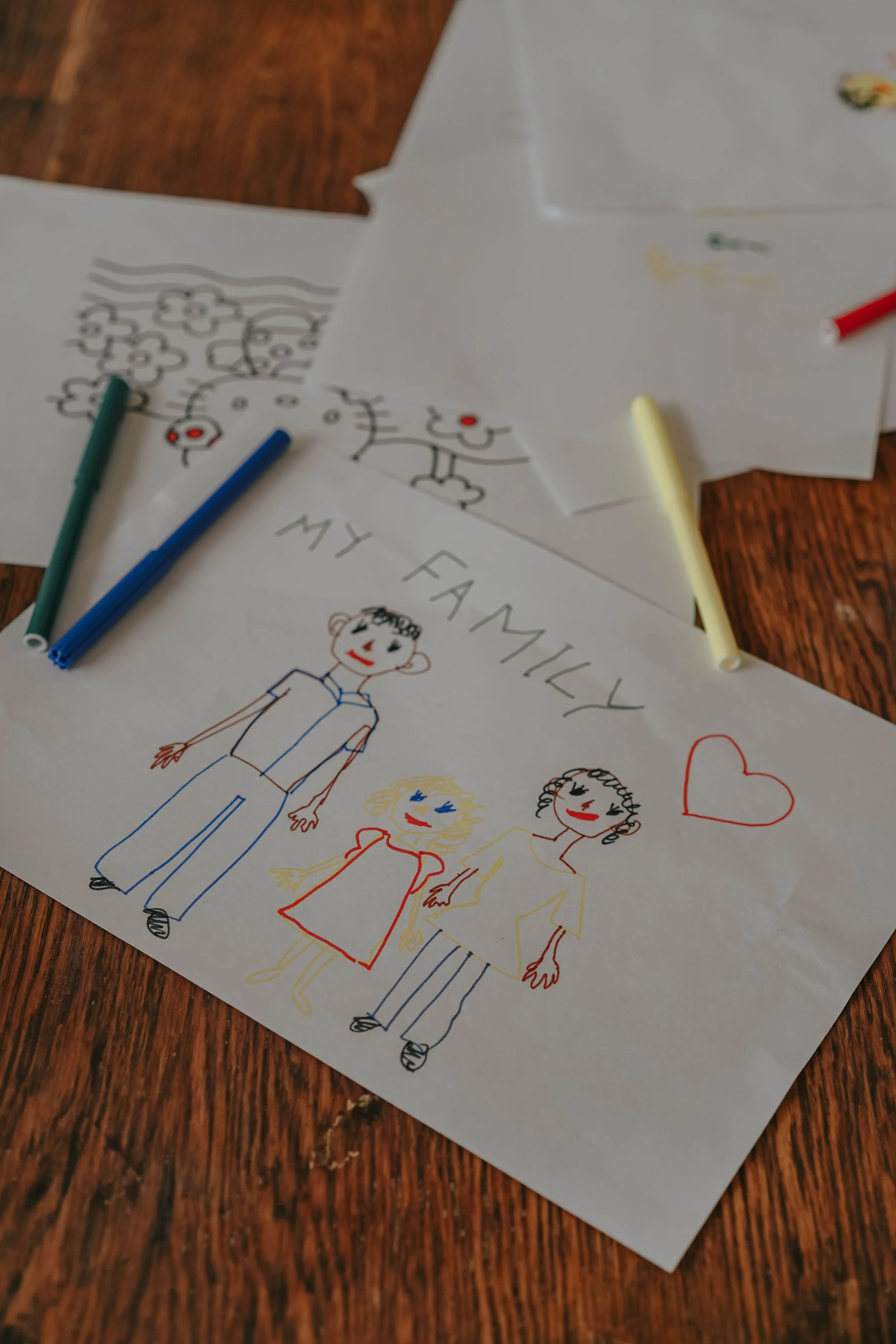
A child hands you a drawing of a stormy sky, or a figure standing alone, or a burst of color with no clear shape at all. It is tempting to ask, "What is it?" Yet often the more meaningful question is, "What are you telling me?" For children, art is rarely just art. It is one of the earliest and most honest languages they have, a way to share an inner world that words cannot yet hold.
At Dancing Dialogue, we see children's creative expression as genuine communication, full of feeling and meaning. In this post, we will explore why children speak so naturally through art, what their creations may be expressing, and gentle ways to listen so your child feels truly understood.
Why Children Speak Through Art
Children feel deeply long before they can explain themselves in words. Their inner lives are rich with emotion, but the part of the brain that turns feelings into language is still growing. Art bridges that gap. A crayon, a lump of clay, or a swirl of paint gives a child a way to make their feelings visible, to take something invisible and inward and bring it into the shared world. This is part of why we treat creativity as central to dance/movement therapy for kids and our broader work with children.
We often begin with the body-mind connection rather than the other way around, trusting that a child's feelings move through the body and the hands before they ever reach the thinking mind. Watching how a child moves while they create, the press of the crayon, the sweep of the arm, the pace of their breath, tells us as much as the finished picture. We listen to how the body speaks, never reading it as a fixed code, but following it as a living, personal story.
Art also gives feelings a safe shape. A worry that feels enormous inside can become small enough to hold once it lives on a page. A child who cannot yet say "I felt scared" can paint a dark storm and, in doing so, set the feeling down for a while. This is one of the quiet gifts of creative expression. It lets children meet big emotions at a comfortable distance, on their own terms, and in their own time.
What a Child's Art May Be Expressing
A child's artwork can carry feelings they have no other way to share, whether joy, worry, excitement, or grief. The goal is never to analyze a drawing like a puzzle to be solved, but to stay curious and let the child guide us toward its meaning. Our creative arts therapy is built on this kind of gentle, child-led listening.
It helps to remember that a child's art is a snapshot of a moment, not a verdict on their whole inner world. A scary monster one day and a sunny garden the next are both simply parts of a child making sense of life. When we hold their creations lightly and with warmth, we give children the freedom to keep exploring, knowing that whatever they share will be met with care rather than worry.
Clues a Child May Be Communicating Something Important
Children's art is wonderfully varied, and no single image means one fixed thing. Still, certain patterns can be worth noticing with warm curiosity, including:
Repeated images or themes that show up again and again, suggesting something a child is working through.
Strong or shifting use of color, where a sudden change in palette may mirror a change in mood.
Where figures are placed, such as people standing close together or far apart, large or very small.
The energy of the marks, from soft and careful to fast, heavy, or scribbled over.
What is left out, since the missing pieces of a picture can be as telling as what is included.
These are invitations to wonder, not conclusions to draw. The most helpful response is almost always a gentle, open question rather than an interpretation.
How to Listen When Your Child Creates
Listening to a child's art is less about decoding and more about being present. When children feel that their creations are received with genuine interest, they learn that their inner world is welcome, and that lesson stays with them. Here are five gentle ways to listen well.
1. Describe Before You Ask
Instead of guessing what a drawing is, try simply noticing it aloud: "You used so much blue here," or "These lines move really fast." Description shows your child you are paying attention without putting them on the spot to explain.
2. Follow Their Lead on Meaning
Let your child be the expert on their own art. Open questions like "Can you tell me about this?" invite them to share as much or as little as they wish, and honor that the meaning belongs to them.
3. Welcome All the Feelings
If a child's art expresses anger, fear, or sadness, resist the urge to brighten it. Saying "that looks like a really big feeling" lets your child know that every emotion is allowed, which is one of the most reassuring messages a child can receive.
4. Notice the Process, Not Just the Picture
Pay attention to how your child creates, whether calmly, intensely, or playfully. The way they move through the making often carries as much feeling as the result, and noticing it gently tells them you see the whole of their experience.
5. Resist the Urge to Fix or Correct
There is no wrong way for a child to express themselves. When you let go of tidiness and accuracy, you give your child the freedom to be honest, and honesty is where real communication begins.
Listening this way, again and again, helps a child feel deeply understood, and that felt sense of being understood supports healthy emotional growth.
When Art Opens a Door to Support
Most of the time, children's art is simply a joyful part of growing up. Now and then, though, it can gently signal that a child is carrying more than they can manage alone, perhaps after a loss, a big change, or a frightening experience. When that happens, creative expression can become a bridge to support, a way for a child to begin sharing what is hard before they have the words for it.
This is where having a whole team matters. If your child needs specialized help, you can work with anyone among our clinicians, each of whom brings their own depth and care. They include Dr. Suzi Tortora (EdD, LCAT, LMHC, BC-DMT, CMA), Dr. Renee Ortega (PhD, BC-DMT, LCAT, COTA/L), and Jenn Whitley (BC-DMT, LCAT, CMA). You are warmly invited to meet the full team and find the right fit for your family.
We see a wonderfully diverse range of children and families across New York City, and we are often able to support children whose needs have not been fully met elsewhere. Through approaches like dance/movement therapy, we help children find many languages for their feelings, supporting their emotional regulation in ways that feel like play rather than work.
It can be a tender thing to wonder whether your child needs more support, and there is no need to wait until something feels like a crisis. Sometimes a child simply benefits from a dedicated space where their feelings can be expressed and met. Reaching out is not a sign that anything has gone wrong. It is a loving way of making sure your child has every language available to them, and that you are not carrying your questions alone.
Bringing It Home
Communication within a family deepens when everyone has room to express themselves. Through family therapy, we help parents and children build a shared creative language, one where feelings can be shown, seen, and understood together. When a child learns that their inner world is welcome at home, they carry that confidence into every other room they enter.
A Gentle Invitation
The next time your child hands you a drawing, you might pause before asking what it is and instead wonder what they are sharing. That small shift, from analyzing to listening, can open a tender new channel between you.
If you would like support in understanding and nurturing your child's expressive world, we would be honored to help. When you feel ready, you are warmly invited to reach out and connect with us. There is no rush, only an open door and a team that delights in helping children's voices be heard.