Dance/Movement Therapy Across the Lifespan
From our very first breath to our last, we live in our bodies. Long before we have words, and long after words begin to feel like too little, the body is still speaking, still holding our joys and sorrows, still reaching toward connection. Dance/movement therapy honors this truth at every age. It meets people through the felt experience of being alive, offering a path toward healing that does not depend on having the right words at the right time.
This post takes a gentle walk through the human lifespan, showing how dance/movement therapy supports people from infancy through older adulthood. Along the way, we hope to offer a sense of how much beauty and strength the body carries, and how creative, embodied care can be a source of peace at any stage of life.
A Body-Mind Approach That Fits Every Age
Many wellness approaches begin with the mind and hope the body will follow. We believe in the reverse. A body-mind approach starts with the felt experience of the body and trusts that as the body settles, softens, and expresses, the mind and heart can follow. This orientation is what makes dance/movement therapy so adaptable across a lifetime, because the body is present and communicating at every age, whether or not a person can speak about it.
It helps to say clearly that dance/movement therapy does not require dancing in any formal sense. It is a felt experience that connects the body to the mind through rhythm, gesture, breath, and creative expression. For an infant, that might be a soothing sway. For an older adult, it might be a small, meaningful gesture of the hand. The form changes, but the essence stays the same: the language of the body is always available to us. Our overview of dance/movement therapy services offers a fuller picture of how this work takes shape.
The Earliest Years: Infancy and Early Childhood
Life begins in movement and sensation. Before language, an infant knows the world through touch, rhythm, warmth, and the felt closeness of a caregiver. This is why Infant and Early Childhood Mental Health places such importance on the body-based, relational experiences that shape a child's earliest sense of safety and self. When we attune to how a baby's body speaks, through their breath, their gaze, their reaching or turning away, we can support connection and regulation from the very start.
Dance/movement therapy in these early years often looks like gentle, playful attunement between child and caregiver. It can help soothe a distressed infant, strengthen the bond between parent and baby, and give families a way to understand what their little one is communicating. Because so much of early experience is stored in the body before it can be spoken, this work can be especially healing.
For families curious about this stage, two of our posts offer a tender starting point: understanding your baby's experience through multisensory factors explores how infants take in the world, and trauma that happens before words and how to heal speaks to the gentle repair that is possible even for the earliest wounds.
Childhood and Adolescence: Growing Through the Body
As children grow, movement remains their primary language for learning, feeling, and connecting. A child processes the world through play and motion, and a teenager, navigating enormous change, often feels far more than they can put into words. Dance/movement therapy gives young people a creative, pressure-free space to express what is happening inside them and to build the emotional steadiness that carries them forward.
This work honors each young person as they are, whether they are working through anxiety, building confidence, moving through a hard transition, or simply learning to trust their own body. Because expression happens through creativity rather than confession, many children and teens find it far easier to open up here than in more talk-focused settings.
What Dance/Movement Therapy Can Offer Young People
Across childhood and the teen years, this approach supports growth in ways that feel more like discovery than work. A few of its gifts include:
Emotional expression for feelings that are hard to name, giving shape to what might otherwise stay stuck inside.
Nervous system regulation, helping a young person find calm and return to it more easily over time.
Self-confidence and body trust, as they experience their own strength, creativity, and capability.
Connection and belonging, through shared movement that invites attunement and the pleasure of being met.
Resilience, the felt sense that they can move through difficulty and come out whole.
These are not lessons taught from the outside. They grow from within, nurtured by a relationship that delights in who the young person already is.
Adulthood: Reconnecting With the Self
Adulthood brings its own weight: work, relationships, caregiving, loss, and the quiet ways we can drift from ourselves over the years. Many adults arrive carrying stress or old pain held in the body, sometimes without fully realizing it. Because the body remembers what the mind has set aside, a purely talk-based approach can only reach so far. Dance/movement therapy and somatic psychotherapy offer a way to listen to the body directly and to release what it has been holding.
For adults, this work can look like reconnecting with a sense of aliveness, easing the grip of long-held tension, or finding steadier ground during a season of change. It supports healing from depression and helps people move through the heavier feelings that words alone cannot lift. It can also enrich relationships, and our couples therapy work draws on the understanding that connection is felt in the body as much as it is spoken. New parents, too, find real support here, as our post on using movement to navigate new parenthood explores.
Older Adulthood: Honoring a Life Lived
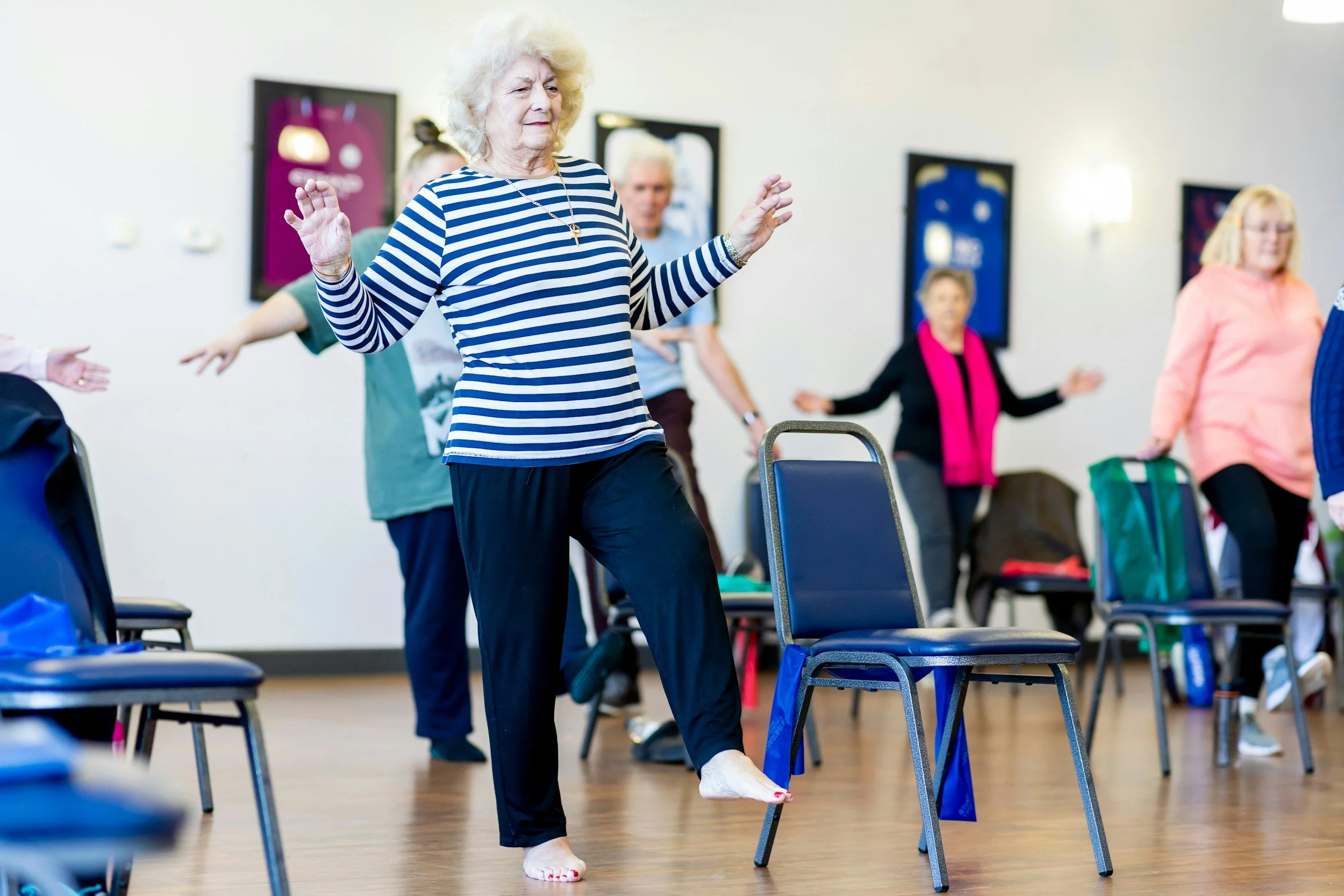
In later years, the body continues to be a source of expression, memory, and connection. Dance/movement therapy meets older adults with deep respect, offering a way to stay engaged, to process grief and change, and to experience joy and vitality regardless of physical ability. A gesture, a sway, a shared rhythm can carry enormous meaning, reconnecting a person to memory, feeling, and the people around them.
This stage of life often holds significant loss, and the body carries grief in ways that ask to be honored rather than rushed. Our work with grief and loss makes space for this, gently and without pressure. Movement can hold sorrow and beauty at once, offering comfort and a felt sense of continuity across a long life.
Beginning Wherever You Are
One of the quiet gifts of this work is that there is no wrong age or stage to start. Wherever you find yourself, care can meet you there. Here is a gentle sense of how the journey often begins.
1. Reaching out
The first step is simply making contact and sharing a little about what brings you or your loved one to this work. There is no need to have the right words or a plan. Curiosity is enough to begin.
2. Finding the right fit
Because our clinicians share broad, overlapping expertise, you do not have to identify the one perfect specialist on your own. We help match you with the care that feels right, and you are always welcome to see anyone on the team.
3. Beginning gently
Early sessions move at your pace, building safety and trust before anything else. The work always follows your readiness, honoring how your body speaks rather than imposing an agenda.
4. Growing over time
From that foundation, healing unfolds in its own rhythm. Whether the goal is regulation, expression, connection, or repair, growth arises from meeting rather than pushing, and it tends to reach into daily life in lovely, lasting ways.
Practical details, including fees and insurance information, are easy to find as you consider taking a first step.
The Strength of a Whole Team
Healing across a lifespan asks for a range of skills and a great deal of heart, and no single person holds it all. Our clinicians bring deep, shared expertise across ages and needs, which means meaningful support is available from anyone on the team.
Dr. Suzi Tortora, EdD, LCAT, LMHC, BC-DMT, CMA, has spent decades bringing the language of the body into healing work with people of all ages. Dr. Renee Ortega, PhD, BC-DMT, LCAT, COTA/L, weaves developmental and body-based understanding through her compassionate care. Jenn Whitley, BC-DMT, LCAT, CMA, is a skilled clinician whose work has also contributed to published scholarship in the field. Because our New York practice welcomes a diverse range of clients, including those whose needs other settings have not been able to hold, we are often able to help when families and individuals have struggled to find the right fit elsewhere. You can browse more of our writing on the blog to get a feel for our approach.
A Lifelong Language of Healing
The body is with us for our whole lives, holding our stories and offering, again and again, a way back to ourselves. Dance/movement therapy trusts this deeply. Whether you are caring for a newborn, walking alongside a growing child, tending to your own adult heart, or honoring the fullness of a long life, there is a gentle, creative path toward healing available to you.
If any of this speaks to you, we would be honored to connect. Reach out to learn how our team can support you or someone you love, at whatever stage of life you find yourselves, with care rooted in beauty, strength, and peace.