Using Movement to Navigate New Parenthood
Becoming a parent transforms everything. While friends and family offer advice about sleep schedules and feeding routines, something deeper often goes unaddressed: the profound physical and emotional transition happening within your own body. At Dancing Dialogue, our team understands that the journey into parenthood is a deeply embodied experience that deserves specialized attention and care that many traditional approaches cannot provide.
Why Movement Matters in Early Parenthood
When we talk about wellness in new parenthood, most conversations center on the mind-body connection. But we believe in flipping that concept entirely. The body-mind connection recognizes that your physical experience of your body comes first, and from that felt sense, understanding emerges.
Your body holds the story of pregnancy, birth, and the monumental shift into caregiving. It remembers the sleepless nights, the tender moments of connection, the waves of overwhelm, and the quiet triumphs. Before you have words for what you're experiencing, your body already knows.
Dance/movement therapy offers something that talk therapy alone cannot reach. When you're navigating postpartum emotions, processing birth experiences, or simply trying to find your footing in this new role, your body needs attention and support. The way you breathe, hold tension, move through space, and offer touch to your baby all communicate volumes about your internal state.
Dance/movement therapy doesn't mean you need to perform choreography or have any dance experience. Instead, it's about honoring the felt experience of your body and using that awareness to find regulation, connection, and peace during one of life's most demanding transitions.
Your Body Speaks: Understanding What You're Communicating
Every parent communicates through the language of the body, whether they realize it or not. Your baby reads this language long before they understand words, picking up on subtle cues that shape their sense of safety and connection. Understanding how your body speaks helps you develop greater awareness and intentionality in your parenting.
The Quality of Your Breath
When you're anxious, your breath becomes shallow and quick, and your baby senses this tension through the body-to-body contact you share.
The Tension in Your Touch
The way you hold, stroke, or support your baby tells a story that differs between loving presence and hurried anxiety.
Your Postural Patterns
The ease or tension in your shoulders, the openness or guardedness in your stance, all communicate your emotional state to your infant.
The Rhythm of Your Movement
Whether you move in jerky, unpredictable patterns or with smooth, consistent flow affects how your baby experiences safety with you.
This doesn't mean you need to be perfectly peaceful at all times. Instead, it's about developing awareness of how the body speaks and learning tools to shift your state when you need support. Our team at Dancing Dialogue specializes in helping parents recognize these patterns and develop new ways of being in their bodies that serve both them and their babies.
Creating the Dancing Dialogue with Your Baby
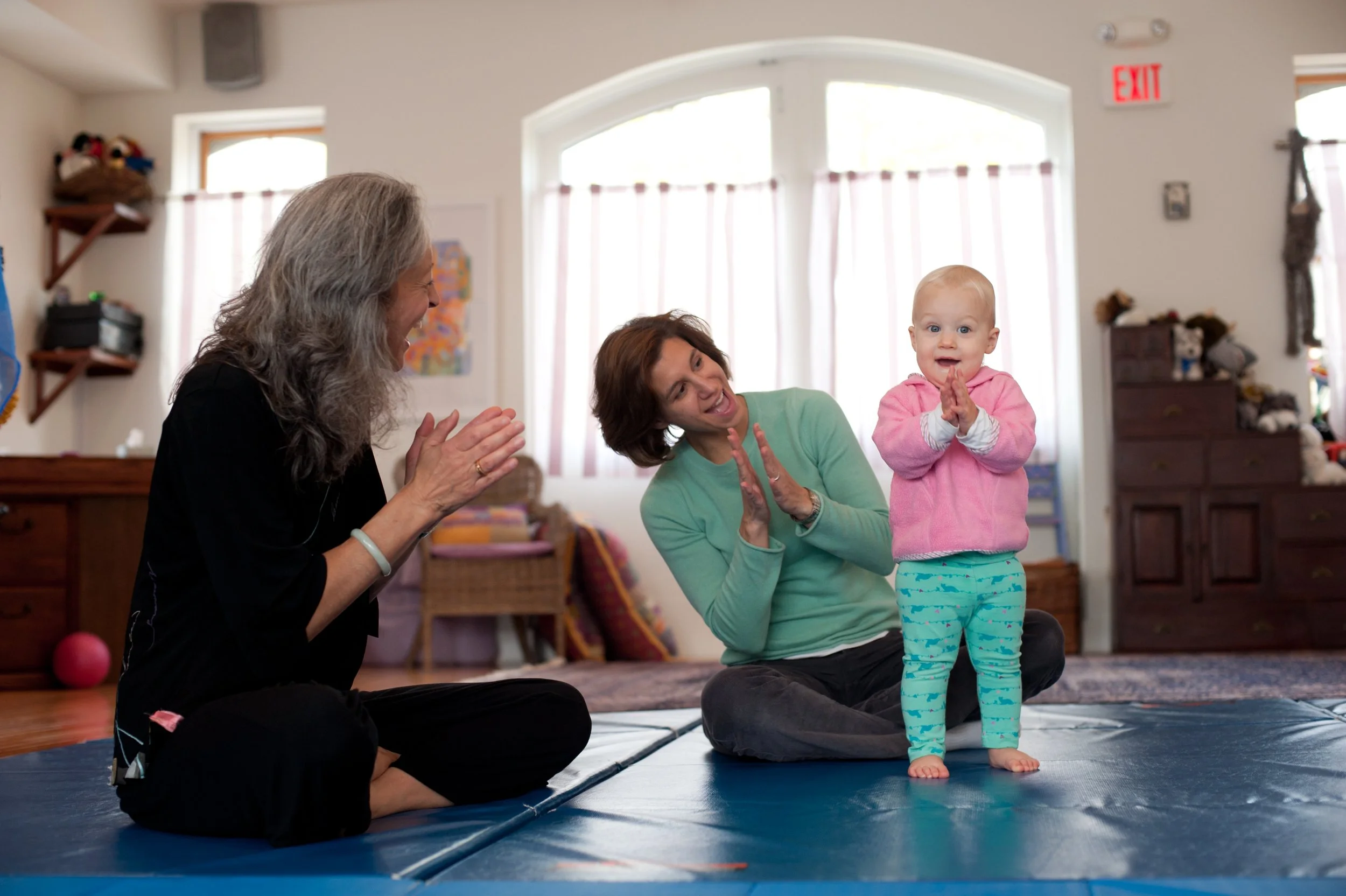
Imagine this: your baby coos and reaches toward you, and without thinking, you lean in closer. Your eyes meet. You smile, and your baby's whole face lights up in response. You sway gently, and your little one softens into your arms. In this moment, you are in a dancing dialogue, a beautiful, wordless conversation flowing between the two of you through presence, rhythm, and touch.
Some days feel exactly like this. The connection is effortless, and the exchange between you and your baby feels like the most natural thing in the world.
Other days, that flow may not come so easily. Maybe your baby is fussy and nothing seems to soothe them. Maybe you feel exhausted, overwhelmed, or disconnected in ways you didn't expect. You might wonder why this doesn't feel as easy or as joyful as everyone says it should. If you've ever felt this way, you are not alone, and there is nothing wrong with you or your baby.
The truth is, the parent-infant relationship is not a performance. It is a living, breathing exchange that has its own rhythm of closeness and distance, harmony and repair. Some moments feel deeply connected, and others feel uncertain or hard. Both are a real and natural part of building a relationship with your child.
This is what the dancing dialogue is really about. Not dance steps or choreography, but the felt experience of being in relationship with your baby through the language of the body. The way you hold, rock, pause, and respond to your little one creates a foundation for attachment and trust that begins long before words. Every small gesture, every moment of eye contact, every time you sway together or simply breathe in each other's presence, contributes to this ongoing conversation.
At Dancing Dialogue, Dr. Suzi Tortora and our team of therapists specialize in supporting this deeply personal exchange. Whether the connection feels easy or challenging, we are here to help you tune into what your body and your baby's body are already communicating, and to nurture the dialogue that is uniquely yours.
Body-to-body contact filled with loving touch creates a deeply emotional connection that goes beyond words or even conscious thought. When you hold your baby, you're not just supporting their physical body. You're providing a felt experience of safety, warmth, and belonging. This is the embodied foundation upon which your relationship grows.
Our team, including Dr. Suzi Tortora, Dr. Renee Ortega, Jenn Whitley, and Jennifer Sterling, has extensive training in supporting parent-infant relationships through this lens. We understand that sometimes the dancing dialogue feels effortless and joyful, while other times it feels strained or uncertain. Both experiences are valid, and both can benefit from specialized support.
Practical Movement Approaches for New Parents
One of the most powerful techniques we teach parents is what we call "layering the senses." This approach helps you use movement, breath, and sensory awareness to engage and soothe both yourself and your baby. These practical tools can be woven into your daily routines to support regulation and connection.
1. Breath Awareness for Nervous System Regulation
Start by simply noticing your natural breathing pattern without trying to change it, then gently extend your exhale one or two counts beyond your inhale to shift toward calm.
2. Rhythmic Movement for Grounding
Use swaying, rocking, or walking with your baby to provide predictable patterns that soothe both of you and help organize the nervous system.
3. Creating Embraced Space
Learn to read when your baby needs close body-to-body contact versus when a bit more space allows exploration while maintaining your reassuring presence.
4. Intentional Touch as Communication
Bring awareness to your hands and the quality of contact you offer, distinguishing between loving, present touch and anxious or hurried handling.
5. Layering Sensory Experiences
Combine movement with sound, visual connection, and touch to create rich, multisensory experiences that deepen your bond.
These approaches aren't about adding more to your already full plate. Instead, they transform everyday moments of caregiving into opportunities for deeper connection and mutual regulation, supporting both you and your baby in finding greater ease.
When You Need Specialized Support
While all new parents benefit from understanding movement and embodiment, some situations call for specialized therapeutic support. Postpartum depression, birth trauma, grief, anxiety, and overwhelming stress all manifest in the body in ways that require expert care.
Our team has particular expertise in areas that traditional therapy often cannot reach. If you're struggling with the transition to parenthood in ways that feel deeper than typical adjustment, dance/movement therapy offers a unique pathway to healing. We work with preverbal experiences, early attachment patterns, and somatic responses that exist below the level of conscious thought or language.
Dr. Tortora's extensive work with parent-infant dyads, particularly addressing postpartum depression and trauma, demonstrates how dance/movement therapy can support healing in ways that talk therapy alone cannot access. Our team members bring specialized training in working with new parents, infants, attachment relationships, and the complex emotional terrain of early parenthood.
Whether you need individual support, parent-infant dyadic therapy, or group connection with other new parents, we offer approaches tailored to your specific needs. You don't have to navigate this journey alone, and you don't have to wait until things feel unbearable to reach out.
Moving Forward Together
The transition into parenthood is one of the most profound transformations you'll ever experience. Your body carries this transition, holds it, and expresses it through the language of movement, breath, posture, and touch. By honoring the body-mind connection and developing embodied awareness, you give yourself and your baby the gift of deeper presence and attunement.
Dance/movement therapy offers new parents a source of strength and peace during a time that can feel overwhelming. It provides practical tools for regulation while also addressing the deeper emotional and relational needs that arise. Our team at Dancing Dialogue brings decades of combined expertise in supporting parents and infants through these early months and beyond.
Remember, this work isn't about perfection. It's about presence. It's about finding moments of connection amid the chaos, learning to read the language of the body, and developing trust in your own embodied wisdom as a parent. We're here to support you in that journey, offering specialized care that addresses what other approaches cannot reach.
If you're a new parent seeking support, or if you're expecting and want to prepare for the embodied journey ahead, we invite you to connect with our team. Together, we can help you navigate new parenthood with greater ease, confidence, and joy.