
WAYS OF SEEING
The Clinical Training Allied Professionals Are Seeking
Learn to read the body's story, an advanced CE program integrating movement, attachment, and development.
You were trained to listen.
But so much of what your clients communicate never becomes words. The infant who arches away from a caregiver. The adolescent who cannot sit still. The adult whose shoulders rise imperceptibly every time they mention home.
These are not incidental behaviors; they are dialogue. And most clinical training programs never teach you how to read it. If you are a psychologist, social worker, occupational therapist, psychiatrist, or any licensed clinician working with children, families, or adults, you have likely sensed the gap between what your clients say and what their bodies reveal. You are not imagining that gap. You are recognizing the limits of a verbally dominant clinical paradigm, and you are ready for something more.
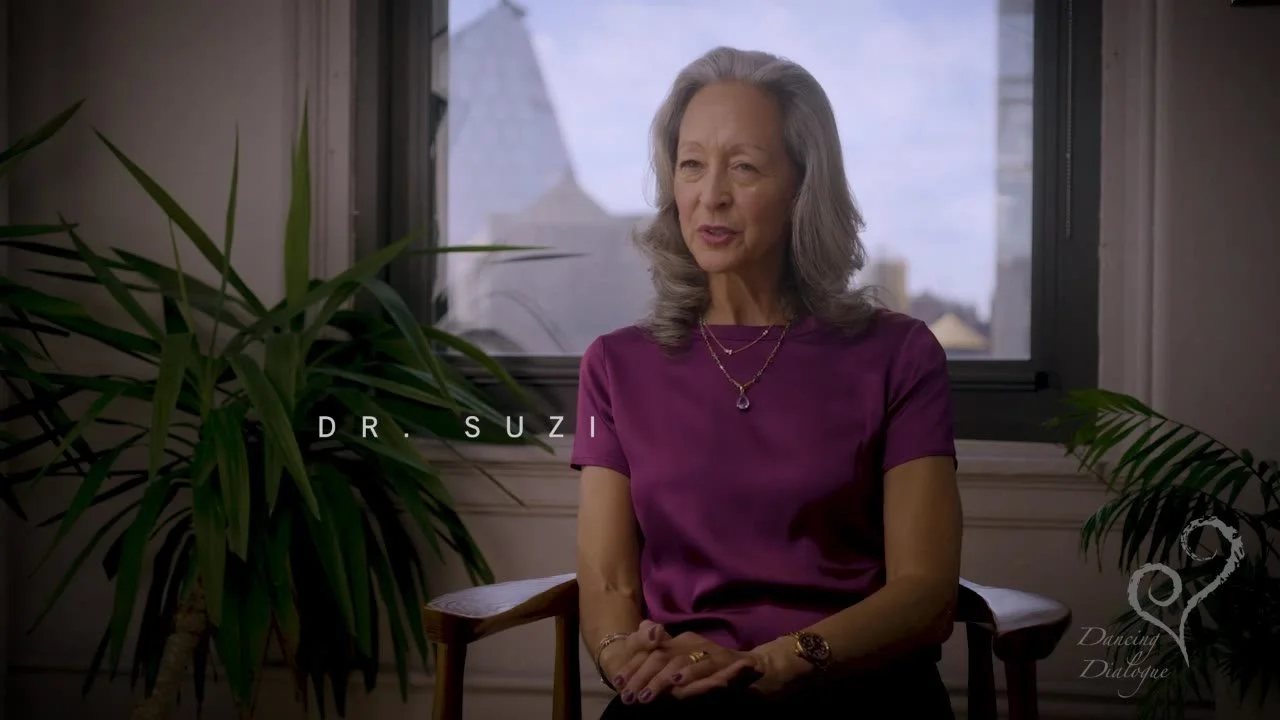
Ways of Seeing is the advanced training program that closes that gap. Developed by Dr. Suzi Tortora, an early innovator in embodied psychotherapy, movement analysis, and infant mental health, this webinar-based continuing education program equips you with a systematic, evidence-informed framework for observing, interpreting, and therapeutically responding to nonverbal and movement-based communication across the lifespan. This is not an introduction to dance therapy. This is a rigorous clinical methodology designed for the allied professional who already has deep clinical skill and wants to add an entirely new dimension of perception.
What makes this moment different is that clinicians outside the dance/movement therapy field are now actively pursuing this work. Psychologists, OTs, social workers, psychiatrists, professionals across disciplines have reached a tipping point of recognizing that body-based understanding is not a specialty niche but a clinical necessity. Ways of Seeing was built for exactly this interdisciplinary demand, and its webinar-based format means you can access it from anywhere in the world.
Our Services
Ways of Seeing is an advanced, webinar-based training program created by Dr. Suzi Tortora through Dancing Dialogue.
It is designed to equip licensed mental health professionals, educators, healthcare providers, and anyone working with people across the lifespan with practical tools for integrating movement observation, attachment theory, and emotional development into their existing clinical and educational practice.
The program does not ask you to abandon your current modality. It deepens it, adding a body-based lens that transforms how you assess, attune, and intervene.
The program is structured as a series of live, interactive webinar sessions that combine didactic instruction, video-based case observation, guided movement-analysis practice, and peer discussion. Each session builds on the previous one, progressively training your capacity to see what has always been present but unrecognized in your clinical encounters, the postural shifts, rhythmic patterns, spatial preferences, and movement qualities that communicate a client's internal world. Dr. Tortora draws on decades of clinical research and her proprietary movement-analysis framework to make these observations systematic, replicable, and clinically actionable rather than impressionistic.
Participants emerge from the program with a fundamentally expanded clinical vocabulary. You will be able to identify early indicators of attachment disruption in infants and young children, recognize sensory-processing patterns that shape behavior, and use your own embodied awareness as a therapeutic instrument. These are skills that enhance individual therapy, couples work, family sessions, group facilitation, and classroom observation alike. Continuing education credits are available, and the cohort model ensures you are learning alongside a community of motivated, interdisciplinary peers who challenge and enrich your perspective throughout the program.
Founded by Dr. Suzi Tortora, Ed.D, BC-DMT, LCAT, LMHC, CMA, NCC, a nationally recognized dance/movement psychotherapist, author, and educator
Board-Certified Dance/Movement Therapist (BC-DMT)
Licensed Creative Arts Therapist (LCAT) and Licensed Mental Health Counselor (LMHC) in New York State
Specializations in embodied psychotherapy, movement analysis, and trauma-informed care
Practice locations in Union Square, Manhattan and Cold Spring, New York
Apply to Expand Your Clinical Practice
How You Benefit
-
Most clinical training teaches you to listen for language, the content of a narrative, the structure of thought, the emotional tone of speech. Ways of Seeing trains an entirely different perceptual channel. Through Dr. Suzi Tortora's movement-analysis methodology, you develop the ability to observe and interpret the nonverbal communication that constitutes the vast majority of human interaction but remains invisible to most clinicians.
This is not intuition dressed up as technique. The framework is systematic. You learn to identify specific movement qualities, effort, shape, spatial orientation, rhythm, and to connect those observations to emotional states, relational patterns, and developmental stages. A child who consistently moves in bound, narrow patterns is telling you something precise about their experience of safety. An adult whose breathing shallows and whose gaze drops when discussing a particular relationship is offering clinical data as valuable as any verbal disclosure. Ways of Seeing teaches you to collect, organize, and therapeutically respond to that data.
What makes this training transformative for allied professionals is that it does not require you to become a dance therapist. It integrates into your existing clinical identity. Whether you practice CBT, psychodynamic therapy, occupational therapy, or developmental psychiatry, the nonverbal-analysis lens amplifies what you already do. Clinicians consistently report that after completing the program, they cannot unsee what they have learned, their sessions become richer, their assessments more nuanced, and their therapeutic relationships more attuned.
-
If you work with infants, toddlers, young children, or parent-child dyads, you know that the therapeutic relationship unfolds almost entirely through the body. Infants do not narrate their experience. They communicate through reach, withdrawal, muscle tone, gaze, rhythm, and proximity. Parents respond, or fail to respond, through their own embodied patterns. Ways of Seeing gives you a clinical framework for reading these exchanges with specificity and confidence.
Dr. Tortora's work sits at the intersection of infant mental health, attachment theory, and movement analysis. The program trains you to observe the micro-interactions between caregiver and child that reveal the quality of attachment, the timing of a parent's response, the spatial distance a toddler maintains, the rhythmic synchrony or dissonance in a feeding or play interaction. These are the moments where relational patterns are formed and where therapeutic intervention can be most powerful, but only if you can see them.
This benefit extends beyond early childhood. The attachment patterns observable in infancy persist across the lifespan, expressed through adult posture, movement preferences, relational proximity, and somatic responses to stress. Ways of Seeing equips you to trace these patterns from their developmental origins through their adult expressions, giving you a longitudinal, body-based understanding of your clients that purely verbal modalities cannot achieve. For clinicians already working within an infant mental health or attachment framework, this training adds the embodied observation skills that make theory actionable in the room.
-
Professional development should challenge you, but it should also count. Ways of Seeing is structured to provide continuing education credits for licensed clinicians, supporting your professional requirements while delivering training that genuinely transforms your practice. The program is designed for mental health professionals, educators, and healthcare providers across disciplines, which means your cohort will include psychologists, social workers, occupational therapists, counselors, dance/movement therapists, psychiatrists, and other allied professionals.
This interdisciplinary composition is not incidental; it is one of the program's most valuable features. When a social worker observes a case video alongside an occupational therapist and a psychologist, the resulting discussion surfaces perspectives that no single discipline could generate alone. You learn to see through multiple clinical lenses simultaneously, which deepens your own observational capacity and challenges assumptions you did not know you held. The cohort model also creates a professional network that extends beyond the program itself, connecting you with colleagues who share your commitment to embodied, relational clinical work.
The webinar-based format makes this accessible regardless of your geographic location. Whether you practice in New York, London, São Paulo, or Melbourne, you can participate in live sessions, engage in real-time discussion, and receive direct mentorship from Dr. Tortora without the cost and disruption of travel. This is graduate-level clinical training delivered with the rigor of an in-person program and the accessibility of a thoughtfully designed virtual experience.
-
The quality of any clinical training depends on the depth of the teacher. Dr. Suzi Tortora brings decades of clinical practice, academic research, and international teaching to every Ways of Seeing session. As a board-certified dance/movement therapist, licensed creative arts therapist, licensed mental health counselor, and certified movement analyst, she holds a rare combination of credentials that span multiple clinical domains. Her doctoral research and ongoing clinical work have focused specifically on the intersection of movement analysis, attachment, and emotional development, the exact territory Ways of Seeing covers.
What distinguishes Dr. Tortora as a teacher is her ability to make sophisticated observational skills accessible to clinicians from any discipline. She does not assume you have a movement background. She meets you where you are professionally and builds your capacity session by session, using video case material, guided observation exercises, and real-time feedback. Her teaching style is rigorous but warm, she models the same attuned, embodied presence she is training you to develop. Participants consistently describe the experience of learning from her as both intellectually demanding and personally transformative.
Dr. Tortora's role as an early innovator in this field means you are not learning a derivative method. You are learning from the person who developed the framework, who has tested it across thousands of clinical hours, and who continues to refine it based on emerging research and clinical experience. This is direct-source mentorship at the highest level, and it is a rare opportunity for clinicians who want to deepen their body-mind practice with confidence and integrity.
-
One of the most common hesitations clinicians express about body-based training is the fear that it will require them to become something they are not. If you are a psychologist, you want to remain a psychologist. If you are an occupational therapist, you have no intention of retraining as a dance therapist. Ways of Seeing is designed with this reality in mind. The program does not replace your modality; it enriches it with an additional layer of clinical perception that makes your existing approach more effective.
This integration happens naturally because the skills you develop are observational and relational, not performative. You are not learning choreography or movement techniques. You are learning to see movement as clinical information, to notice the quality of a client's gesture, the rhythm of their breathing, the spatial patterns they create in the therapy room, and to understand what those observations mean within your existing theoretical framework. A psychodynamic therapist will find that movement observation deepens their understanding of transference. A CBT practitioner will discover behavioral data they were previously missing. An OT will refine their sensory-processing assessments with greater nuance.
The result is that you return to your practice not as a different kind of clinician but as a more perceptive, more attuned version of the clinician you already are. Your clients feel the difference immediately, they feel more seen, more understood, more accurately met, even if they cannot articulate why. This is the practical power of embodied clinical skill: it operates beneath the level of language, in the relational space where healing actually happens.
-
The field of mental health is shifting. Decades of neuroscience research on embodied cognition, polyvagal theory, and the somatic dimensions of trauma have made it increasingly clear that effective clinical work must engage the body, not just the mind. Yet most graduate programs and continuing education offerings still prioritize verbal and cognitive approaches. The result is a growing gap between what research demonstrates and what clinicians are trained to do. Allied professionals across disciplines are recognizing this gap, and actively seeking training to close it.
Ways of Seeing exists at exactly this intersection. It is not a program that asks you to adopt an unfamiliar paradigm. It is a program that gives you the skills to practice in alignment with what the evidence now demands. The fact that psychologists, psychiatrists, social workers, and occupational therapists, not only dance/movement therapists, are enrolling in growing numbers reflects a genuine tipping point in the field. Body-based clinical understanding is no longer a niche interest. It is becoming a professional expectation, and clinicians who develop these skills now position themselves at the leading edge of their disciplines.
By joining a Ways of Seeing cohort, you are not just earning CE credits or adding a line to your CV. You are making a strategic investment in the direction your field is moving. You are equipping yourself with competencies that will define excellent clinical practice in the coming decade. And you are joining a growing international community of professionals who share the conviction that truly seeing your clients, in their bodies, in their movement, in their unspoken experience, is not optional. It is essential.
How We Help
Movement Observation and Nonverbal Analysis
Learn to systematically observe and interpret movement qualities, postural patterns, spatial behavior, and rhythmic dynamics as clinical data. This specialty forms the core of the Ways of Seeing framework and equips you with a replicable methodology for reading the body's communication in any therapeutic context.
Somatic and Embodied Psychotherapy Integration
Explore how somatic awareness, embodied attunement, and movement-based intervention can be integrated into your existing clinical modality, whether psychodynamic, cognitive-behavioral, developmental, or trauma-focused. This specialty ensures that body-based skills enhance rather than replace your professional identity and therapeutic approach.
Attachment and Infant Mental Health Through the Body
Develop embodied observation skills for assessing parent-child dyadic interaction, infant communication, and early attachment patterns. This specialty integrates movement analysis with attachment theory to give clinicians working with families and young children a powerful, body-based assessment and intervention lens. Clinicians learn to identify micro-interactions that reveal relational quality, timing, proximity, rhythmic synchrony, and to use these observations to guide developmentally attuned therapeutic responses.
Lifespan Developmental Movement Patterns
Trace the developmental trajectory of movement from infancy through adulthood, understanding how early movement patterns shape emotional regulation, relational capacity, and psychological well-being across the lifespan. This specialty gives clinicians working with any age group a developmental, body-based framework for assessment and treatment planning.
Interdisciplinary Clinical Application
Learn to apply movement-analysis and embodied-observation skills within the specific context of your discipline, psychology, social work, occupational therapy, psychiatry, education, or counseling. This specialty emphasizes practical integration, helping you translate new perceptual skills into the documentation, assessment, and intervention formats your field requires.
Our Process
STEP ONE
Apply and Share Your Professional Background
Your journey begins with a brief application where you share your clinical credentials, current practice focus, and what draws you to embodied and movement-based clinical work. This is not a gatekeeping exercise; it helps Dr. Tortora and the program team understand each cohort's composition so that content, case examples, and discussion can be tailored to the disciplines represented. The application takes approximately 15–20 minutes. You will receive a response within two weeks confirming your enrollment status and providing cohort details. Apply through the contact page to begin.
STEP TWO
Join Your Interdisciplinary Cohort and Orientation
Once accepted, you are welcomed into a small, curated cohort of licensed clinicians from multiple disciplines and geographic locations. An orientation session introduces you to the program structure, the movement-analysis framework you will be learning, and your fellow cohort members. This is where the interdisciplinary richness of the program begins. You will meet colleagues whose clinical perspectives differ from yours but whose commitment to embodied practice mirrors your own. Orientation is conducted live via webinar and typically lasts 60–90 minutes.
STEP THREE
Engage in Live Webinar Sessions with Dr. Tortora
The core of the program consists of a structured series of live, interactive webinar sessions led by Dr. Suzi Tortora. Each session combines didactic teaching, video-based case observation, guided movement-analysis exercises, and facilitated peer discussion. You will progressively develop your capacity to observe, interpret, and respond to nonverbal and movement-based communication. Sessions are designed for deep engagement; you will be an active participant, not a passive viewer. The series unfolds over multiple weeks, allowing time for integration and practice between sessions.
STEP FOUR
Practice, Reflect, and Receive Mentorship
Between sessions, you apply what you are learning in your own clinical practice. The program includes structured reflection activities and opportunities to bring your observations back to the cohort for discussion and feedback. Dr. Tortora provides direct mentorship, offering guidance on how to refine your observational skills and integrate them into your specific clinical context. This iterative cycle of learning, practicing, reflecting, and receiving feedback is what transforms theoretical knowledge into embodied clinical competence.
STEP FIVE
Complete the Program and Earn CE Credits
Upon completing all program components, you receive your continuing education credits and a certificate of completion from Dancing Dialogue. More importantly, you leave the program with a fundamentally expanded clinical capacity, the ability to see, interpret, and respond to the nonverbal dimensions of your clients' experience. You also retain access to the professional network of your cohort and information about advanced training opportunities as they become available.
Our Approach
At the heart of Ways of Seeing is a conviction that the body is not a container for the mind, it is the mind's first and most fundamental language.
Dr. Suzi Tortora's clinical philosophy holds that movement is meaning, that nonverbal behavior is not noise to be filtered out but signal to be understood, and that the capacity to read that signal is a learnable, teachable skill. This is the philosophical foundation of the program: embodied observation is not a gift reserved for a few intuitively gifted clinicians. It is a clinical competence that can be developed through structured training, deliberate practice, and expert mentorship.
The methodology of Ways of Seeing draws on established frameworks in Laban Movement Analysis, developmental psychology, attachment theory, and infant mental health, synthesized through Dr. Tortora's decades of clinical application and research. Each session is structured to build observational skill progressively, beginning with foundational concepts of effort, shape, space, and rhythm, and advancing toward complex clinical applications such as dyadic interaction analysis, developmental movement assessment, and somatic attunement in the therapeutic relationship. Video case material is central to the teaching method, providing a shared observational field that allows cohort members to practice seeing together, compare perceptions, and develop intersubjective observational reliability.
What distinguishes this approach from other body-based trainings is its rigor and its respect for your existing clinical identity. The program does not ask you to adopt a new therapeutic ideology. It offers a perceptual upgrade, a new channel of clinical information that integrates with whatever modality you already practice. Dr. Tortora's teaching is grounded in the same compassion and intuitive connection that define Dancing Dialogue's clinical work: she creates a learning environment where professionals feel safe to not know, to observe without rushing to interpret, and to develop genuine embodied competence at their own pace. The result is a training experience that is both intellectually demanding and deeply humanizing.
Frequently Asked Questions About Ways of Seeing
Dancing Dialogue is a creative arts psychotherapy practice founded by Dr. Suzi Tortora in New York, with locations in Manhattan's Union Square and Cold Spring, NY. The practice specializes in dance/movement therapy, creative arts therapy, EMDR, and somatic, trauma-informed approaches for children, families, and adults. Ways of Seeing is the practice's advanced professional training program, extending Dr. Tortora's clinical expertise to licensed clinicians worldwide.
-
No. Ways of Seeing is designed specifically for allied professionals, psychologists, social workers, occupational therapists, psychiatrists, counselors, educators, and other licensed clinicians, who do not have dance/movement therapy training. The program teaches observational and analytical skills that integrate into your existing clinical framework. No movement experience is required.
-
The program is delivered entirely via live, interactive webinar sessions, making it accessible to clinicians worldwide. You will need a reliable internet connection and the ability to attend sessions in real time. Past cohorts have included participants from multiple countries. Time zones and scheduling details are provided upon acceptance.
-
Continuing education credits are available for licensed clinicians. Specific credit types and hours vary by cohort and are confirmed during the enrollment process. If you have particular CE requirements from your licensing board, contact us at
[ assistant@dancingdialogue.com](mailto:assistant@dancingdialogue.com) and we will confirm whether the program meets your needs.
-
Cohorts are intentionally kept small to ensure meaningful interaction, peer discussion, and direct mentorship from Dr. Tortora. You will not be an anonymous participant in a large lecture, the program is designed for active engagement, and Dr. Tortora provides personalized feedback on your observational development throughout the series.
-
No. Ways of Seeing adds a body-based observational lens to your current practice; it does not replace your modality. Whether you practice CBT, psychodynamic therapy, occupational therapy, or another approach, the skills you develop will enhance your existing clinical work by expanding the range of information you can perceive and respond to.

Your Clients Are Already Speaking
Learn to hear what their bodies are saying. Apply for the next Ways of Seeing cohort.