TODDLER
Movement & Music Classes for Toddlers in NYC
Where your toddler's natural impulse to move becomes the foundation for lasting connection.
You already know your toddler is wired to move.
They spin, stomp, reach, and rock, not because they need to burn off energy, but because movement is how they process the world.
The problem is that most toddler classes treat this instinct as entertainment. Fun songs, bright props, thirty minutes, goodbye. Your child deserves more than a performance. They deserve a space where their movement actually means something, to them and to your relationship.
Dancing Dialogue's Movement & Music classes for toddlers ages 1–3 are designed by Dr. Suzi Tortora, a licensed psychotherapist and board-certified dance/movement therapist with decades of experience in infant and early childhood development. These are not drop-in enrichment classes. They are carefully structured therapeutic experiences rooted in attachment theory, somatic awareness, and creative arts psychotherapy. Every session is built to help you and your child communicate more deeply through the body, the first and most powerful language your toddler knows.
And because we are located in the heart of Union Square, you have access to a clinical-quality developmental experience without leaving Manhattan. For NYC parents navigating the overwhelming landscape of toddler programming, this is something different: a class where the relationship between you and your child is the curriculum.
Our Services
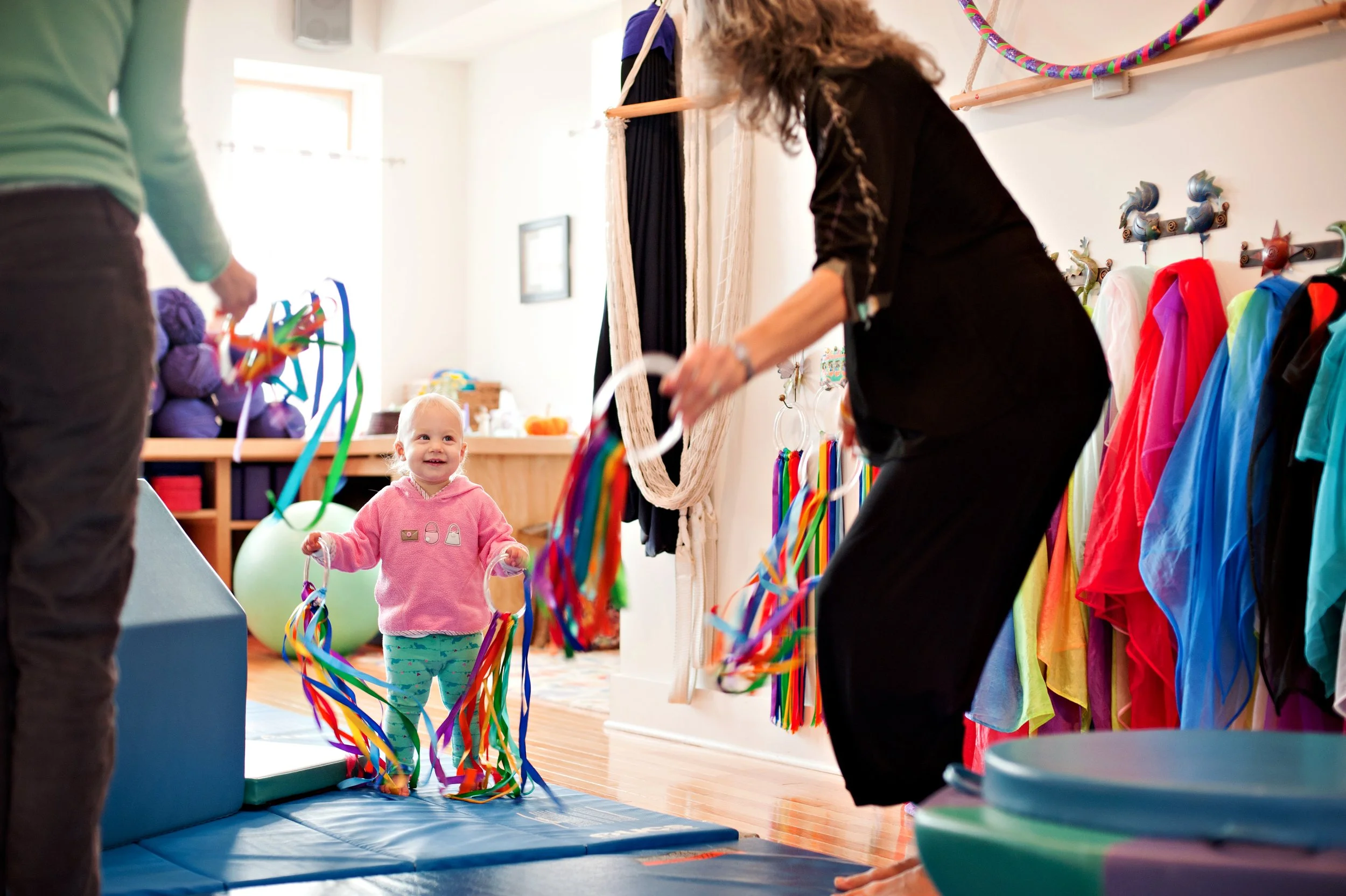
Movement & Music for Toddlers (Ages 1–3) is a caregiver-child class that uses developmentally informed movement, music, and creative play to strengthen the bond between you and your toddler while supporting their emotional and sensory development.
Rooted in dance/movement therapy and creative arts therapy principles, each session is facilitated by a trained therapist who understands both early childhood development and the nuances of the parent-child relationship.
Each class follows a predictable, rhythmically grounded structure, welcoming rituals, guided movement exploration, musical interaction, and a calming closing that gives toddlers the safety of routine while inviting spontaneous expression. Within this framework, your child learns to regulate their body, respond to social cues, and explore their environment with growing confidence. You learn to observe and respond to your child's nonverbal communication in real time, deepening your attunement in ways that carry over long after class ends.
Classes are offered in multi-week series, both 6-class and 9-class options, so that relationships within the group can develop and your child can build familiarity with the space, the facilitator, and the other families. This is intentional. Meaningful developmental work does not happen in one-off sessions. It happens through repetition, trust, and a holding environment that grows stronger over time.
The outcome is not a toddler who can perform a dance or clap on cue. The outcome is a child who feels seen, a caregiver who feels more confident, and a relationship that has a richer physical vocabulary for connection. This is the therapeutic difference that sets Dancing Dialogue's toddler programming apart from conventional music and movement classes across New York City.
Founded by Dr. Suzi Tortora, Ed.D, BC-DMT, LCAT, LMHC, CMA, NCC, a nationally recognized dance/movement psychotherapist, author, and educator
Board-Certified Dance/Movement Therapist (BC-DMT)
Licensed Creative Arts Therapist (LCAT) and Licensed Mental Health Counselor (LMHC) in New York State
Specializations in embodied psychotherapy, movement analysis, and trauma-informed care
Practice locations in Union Square, Manhattan and Cold Spring, New York
Reserve Your Spot in an Upcoming Toddler Class
How You Benefit
-
Attachment is not built through words. For a child between the ages of one and three, the primary channel of connection is the body, touch, rhythm, proximity, gaze. When you and your toddler move together in a structured, supportive environment, you are practicing the fundamental skills of attunement: reading each other's cues, matching energy, and co-regulating emotional states.
In most toddler classes, parents sit on the sidelines or follow along passively. In Dancing Dialogue's Movement & Music classes, you are an active participant in every moment. The facilitator guides you to notice your child's movement impulses, how they reach, how they pause, how they respond to changes in tempo, and to respond in ways that deepen your connection. This is attachment work happening in real time, informed by the same principles used in clinical dance/movement therapy and infant mental health practice.
For NYC parents who are balancing demanding schedules with the desire to be truly present, this class offers something rare: a protected hour where the relationship is the only thing that matters. There are no screens, no distractions, no pressure to produce an outcome. Just you and your child, communicating through the body, building a foundation of trust that will shape how they relate to the world for years to come. Parents consistently report that the attunement skills they develop in class transform everyday moments, mealtimes, transitions, bedtime, into opportunities for connection rather than conflict.
-
The period between ages one and three represents one of the most rapid phases of neurological development in your child's life. During this window, toddlers are building the neural pathways for emotional regulation, sensory integration, body awareness, and social engagement. Movement is the primary mechanism through which this development occurs, not flash cards, not screen time, not passive observation.
Dancing Dialogue's classes are designed with this developmental reality at the center. Each session incorporates elements that target specific sensory and emotional competencies: proprioceptive input through jumping and pressing, vestibular stimulation through spinning and swaying, auditory processing through live music and rhythmic patterns, and emotional regulation through guided transitions between high-energy and calming activities. These are not random choices. They reflect Dr. Suzi Tortora's decades of clinical research and practice in using movement analysis to support child development.
For families in New York City, where toddlers are often navigating intense sensory environments, subway rides, crowded parks, apartment living, these classes provide both a respite and a training ground. Your child learns to organize sensory input in a safe, calibrated space, building capacities they then carry into the unpredictable world outside. If your toddler struggles with transitions, is easily overwhelmed, or seems to seek or avoid certain types of sensory input, this class offers a therapeutic framework for meeting those needs, without the pressure or stigma of a clinical setting.
-
Before your toddler has the words to tell you what they feel, they are telling you with their body. The way they lean toward you or pull away. The tempo of their movements when they are excited versus anxious. The tension in their shoulders when they are overwhelmed. Most parents sense these signals intuitively but do not have a framework for interpreting or responding to them consistently.
Dancing Dialogue's Movement & Music classes teach you that framework. Drawing from Laban Movement Analysis and developmental movement theory, the same tools used by board-certified dance/movement therapists in clinical practice, the facilitator helps you observe your child's movement qualities with new precision. You begin to notice patterns: that your toddler's sudden stillness is not defiance but overstimulation, that their repetitive bouncing is self-regulation, that their reaching toward another child is a bid for connection that deserves acknowledgment.
This is a skill set that transforms parenting. In a city like New York, where you are constantly making rapid decisions in unpredictable environments, navigating a meltdown on the subway, reading your child's readiness at a crowded playground, and knowing when they need to leave a birthday party, the ability to read nonverbal cues accurately is not a luxury. It is essential. Parents who complete a full class series often describe a shift in how they understand their child, a vocabulary of movement that makes them feel more confident, more patient, and more connected. You are not just taking a class. You are developing a clinical-grade observation skill that will serve your family for years.
-
Many NYC parents sense that their toddler could benefit from more than a standard enrichment class but are not ready, or do not feel the need, to pursue formal therapy. Dancing Dialogue's Movement & Music classes occupy this important middle ground. Every session is informed by clinical expertise in dance/movement therapy, creative arts therapy, and infant mental health, but the experience feels like a warm, joyful class, not a diagnostic evaluation.
This is by design. Dr. Suzi Tortora founded Dancing Dialogue with the understanding that therapeutic principles are most powerful when they are woven into natural, everyday experiences. The facilitator creates a holding environment where both caregiver and child feel safe to explore, express, and connect. If a child is struggling with a particular developmental challenge, sensory sensitivity, difficulty with transitions, social hesitancy, the facilitator can gently adjust the experience to meet that child's needs without singling them out or labeling the behavior.
For parents who have been let down by previous therapy experiences, or who are simply looking for something more intentional than the average toddler class in Manhattan, this approach removes barriers. There is no intake form, no diagnosis required, no clinical language to navigate. There is simply a thoughtfully designed space where your child's natural movement is honored as meaningful communication, and where your relationship with your child is the focus. Many families who begin in these classes later transition into individual or family therapy with Dancing Dialogue when they are ready, having already built trust with the practice and its approach.
-
The transition to preschool is one of the most significant social-emotional milestones in a toddler's life. Children who enter group settings with a foundation of body awareness, emotional regulation, and secure attachment are better equipped to navigate separation, share space with peers, follow group rhythms, and express their needs, all skills that preschool readiness assessments evaluate but that few enrichment programs explicitly build.
Dancing Dialogue's Movement & Music classes address these competencies directly. Through guided group movement, turn-taking with instruments, shared creative play, and structured transitions, your toddler practices the exact skills they will need when they walk into a preschool classroom. But unlike academic readiness programs that drill cognitive milestones, this class builds readiness from the body up, the way toddlers actually learn.
The emphasis on co-regulation between caregiver and child is particularly relevant for preschool preparation. Children who have practiced moving between connection with a caregiver and independent exploration in a safe, structured environment develop a more flexible attachment style. They learn that separation is not loss, it is a rhythm. They learn to return to a calm baseline after moments of excitement or frustration. These are the capacities that determine not just whether a child can survive their first week of preschool, but whether they can thrive in group learning environments for years to come. For NYC parents who are already thinking about the preschool landscape, investing in your child's social-emotional foundation now is one of the most consequential decisions you can make.
-
Context matters in therapy. The anxiety you carry is not abstract; it is shaped by the specific demands of your environment. The sensory intensity of the city. The professional pressure to perform at an unsustainable level. The financial weight of living here. The social complexity of maintaining relationships when everyone is running on empty. The particular loneliness of being surrounded by millions of people and still feeling unseen. A therapist who understands these pressures does not need you to explain them. They can meet you where you already are.
Dancing Dialogue has been serving New Yorkers from our Union Square office for years. Our clinical team holds advanced training in Dance/Movement Therapy, Creative Arts Therapy, EMDR, and somatic approaches, and they bring this expertise to bear on the specific presentations of anxiety that urban life produces, the chronic overstimulation, the perfectionism, the relational strain, the body that never fully comes down from high alert. We work with adults who are accomplished and exhausted, who present well and suffer quietly, who have tried multiple therapists and still feel the buzzing in their chest.
Our Union Square location at 41 Union Square West is accessible from nearly every subway line, making it easy to build therapy into your schedule without the logistical friction that becomes one more source of stress. We understand that for therapy to work, it has to be something you can actually get to, consistently, without heroic effort. You have enough of those already.
How We Help
Movement & Music for Toddlers (Ages 1–3)
Our signature caregiver-child class series uses guided movement, live music, and creative play to strengthen attachment and support developmental milestones. Available in 6-class and 9-class series at our Union Square studio. Designed for toddlers and their caregivers who want more than entertainment, a therapeutically informed experience that builds connection.
Creative Arts Therapy
Integrates visual art, movement, music, play, and expressive activities into the psychotherapeutic process. Ideal for children, adolescents, and adults who respond more fully to experiential modalities than traditional talk therapy. Sessions are tailored to individual needs and developmental stages.
Dance/Movement Therapy
Individual and family dance/movement therapy sessions with licensed clinicians. This modality uses the body as the primary vehicle for emotional processing, making it especially effective for young children, nonverbal communicators, and anyone seeking a somatic approach to healing. Available at both NYC and Cold Spring locations.
Individual Therapy for Adults
Our individual therapy sessions are tailored to your specific experience of anxiety and draw from Creative Arts Therapy, somatic practices, and trauma-informed approaches. This is a collaborative, deeply personal process designed for adults who want more than symptom management, who are ready to change their relationship with their own nervous system.
Individual Therapy for Adults
Our individual therapy sessions are tailored to your specific experience of anxiety and draw from Creative Arts Therapy, somatic practices, and trauma-informed approaches. This is a collaborative, deeply personal process designed for adults who want more than symptom management, who are ready to change their relationship with their own nervous system.
Our Process
STEP ONE
Choose Your Class Series
Browse the available Movement & Music for Toddlers sessions on our [Workshops & Events page](/workshops-and-events). Classes are offered in 6-class and 9-class series, each held at our Union Square studio. Review the schedule, select the series that fits your family's availability, and note the age range (1–3 years) and class size. Groups are kept intentionally small to preserve the intimacy and quality of the experience. Most families choose their series based on schedule fit, but our team is happy to help you decide which format is right for your child's developmental stage.
STEP TWO
Register and Prepare
Complete your registration online through our secure booking system. Once registered, you will receive a confirmation with details about what to expect, what to wear (comfortable clothing for movement), and how to prepare your toddler for the first session. No prior experience with movement, music, or therapy is needed. The only requirement is a willingness to be present and to move with your child. If your toddler has specific developmental needs or sensory sensitivities, you are welcome to share that information so the facilitator can create the most supportive experience possible.
STEP THREE
Attend Your First Session Together
Arrive at our Union Square studio a few minutes early to settle in. Each session lasts approximately 45 minutes and follows a consistent structure, welcoming ritual, guided movement exploration, musical interaction, and calming closure. The facilitator will guide you and your child through every element, meeting your toddler exactly where they are. There is no pressure to perform or participate in a specific way. Some toddlers dive in immediately; others observe from a caregiver's lap for the first few sessions. Both responses are welcomed and understood as meaningful.
STEP FOUR
Deepen the Experience Over the Series
As the weeks progress, you will notice changes in your child's confidence, in your own attunement, and in the group's sense of connection. The repetition of rituals and activities is intentional, allowing toddlers to build mastery and caregivers to refine their observational skills. By the end of the series, families often describe a shift in how they relate to each other at home, not just in the studio. Many families choose to re-enroll for subsequent series to continue building on what they have developed.
Our Approach
At Dancing Dialogue, we believe that the body is the first language, and for toddlers, it is still the primary one.
Our approach to movement and music programming is grounded in the same clinical principles that guide our psychotherapy practice: attachment theory, somatic awareness, and the conviction that meaningful change happens through relationship, not instruction.
Every element of our toddler classes is designed with intentionality. The tempo of the music, the texture of the props, the pacing of transitions between activities, none of it is arbitrary. Our facilitators draw from Laban Movement Analysis, developmental movement theory, and creative arts therapy to create sessions that are both joyful and therapeutically sound. We do not follow a rigid curriculum. Instead, we follow the children, observing their movement impulses, responding to their energy, and adapting in real time to what the group needs. This is what distinguishes a therapeutically informed class from a scripted one.
We also center the caregiver in the experience, not as an audience member but as a co-participant. Our work is deeply influenced by infant mental health research, which consistently demonstrates that the quality of the caregiver-child relationship is the single most important predictor of a child's emotional and social development. When we help a parent notice how their toddler uses movement to communicate, and when we help that parent respond with greater attunement, we are not just improving a class experience. We are strengthening a relationship that will shape that child's life.
This approach reflects Dr. Suzi Tortora's founding vision for Dancing Dialogue: that therapeutic tools should not be locked behind clinical doors. Families in New York City deserve access to the same depth of understanding and care in a community class setting that they would receive in a private therapy session. Our Movement & Music classes for toddlers are one expression of that commitment, and for many families, they become the entry point to a deeper relationship with our practice and its philosophy of embodied healing.
Frequently Asked Questions About Toddler Movement & Music
Dancing Dialogue is a creative arts psychotherapy practice founded by Dr. Suzi Tortora, serving children, families, and adults from locations in Union Square, Manhattan, and Cold Spring, New York, for over two decades. Our clinicians specialize in dance/movement therapy, EMDR, and somatic, trauma-informed approaches to emotional healing and connection.
-
Most toddler music and movement classes focus on entertainment and socialization. Our classes are designed by a licensed psychotherapist and board-certified dance/movement therapist, grounded in attachment theory and developmental movement science. Every session is structured to strengthen the caregiver-child relationship and support your toddler's emotional, sensory, and social development, not just keep them busy. Learn more about our [therapeutic approach](/about).
-
No prior experience is needed, for your toddler or for you. Our classes meet every child exactly where they are developmentally. Some toddlers move freely from the first session; others prefer to observe from a caregiver's lap for several weeks. Both responses are completely normal and are understood as meaningful by our facilitators. There is no expectation to perform or participate in a specific way.
-
Classes are kept intentionally small, typically six to eight caregiver-child pairs, to preserve the intimacy and quality of the experience. Each session is approximately 45 minutes and follows a consistent, rhythmically grounded structure that gives toddlers the safety of predictability while inviting spontaneous expression.
-
Our classes are offered in 6-class and 9-class series rather than drop-in formats. This is intentional. Developmental and relational work requires consistency, trust, and repetition. The multi-week format allows your child to build familiarity with the space, the facilitator, and the other families, and it allows you to deepen your observational skills over time. View upcoming series on our [Workshops & Events page](/workshops-and-events).
-
Yes. Our facilitators are trained in sensory processing, somatic experiencing, and working with children across the developmental spectrum, including those with autism spectrum differences, ADHD, and sensory processing challenges. If your child has specific needs, we encourage you to share that information at registration so we can tailor the experience. For children who may benefit from more individualized support, we also offer [individual dance/movement therapy](/services) and [family therapy](/services).