
GROUP
Group Therapy in NYC, Heal Together
Experience the power of co-regulation, shared movement, and community-based healing in Manhattan.
You've done the work in individual therapy.
You've built awareness, named your patterns, maybe even grieved what needed grieving. But something still feels incomplete.
Insights that make sense in a one-on-one session can feel fragile when you step back into the complexity of relationships, workplaces, and daily life. You may find yourself wondering: Why do I still freeze in groups? Why can I articulate my needs alone but lose my voice the moment someone else is in the room? This gap, between knowing and embodying, is exactly what group therapy is designed to close.
At Dancing Dialogue in NYC, our group therapy sessions add a layer that individual work simply cannot replicate: the experience of being witnessed, held, and transformed in relationship with others. Drawing on dance/movement therapy, creative arts therapy, and somatic, trauma-informed approaches, our groups create a space where healing happens not just through insight but through your body's felt experience of safety and belonging with other people. You don't need to be a dancer. You don't need to be graceful. You just need to be willing to show up.
For New Yorkers navigating the paradox of living surrounded by millions of people yet feeling profoundly alone, group work offers something radical: genuine co-regulation. In a city that rewards independence and self-sufficiency, our Union Square studio provides a rare container where slowing down, being seen, and allowing yourself to be affected by others isn't weakness. It’s the work. And it's some of the most powerful therapeutic work available.
Our Services
Group therapy at Dancing Dialogue is a facilitated therapeutic experience in which a small number of adults come together under the guidance of a trained therapist to explore shared challenges, build relational skills, and support one another's growth.
Every session is led by a licensed creative arts therapist trained in movement-based and somatic approaches.
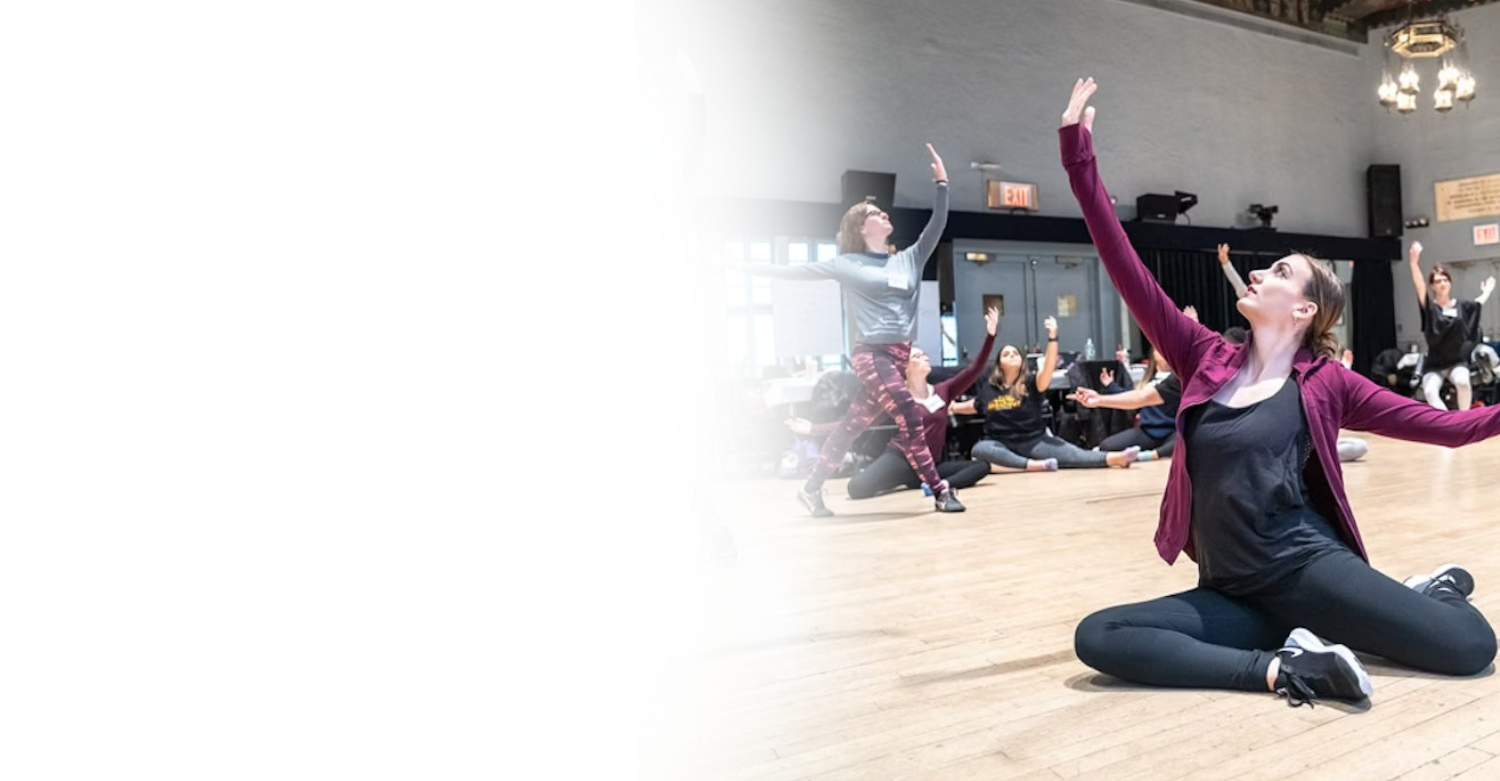
Each group session follows a thoughtful arc. You'll begin with grounding and arrival, a chance to land in your body and notice what you're carrying into the room. From there, the therapist introduces movement-based and expressive prompts designed to help participants explore themes like boundaries, trust, grief, connection, or self-expression. These are not choreographed exercises. They are invitations, to reach, to pause, to take up space, to be still, to notice what happens when someone moves toward you or away. The session closes with verbal reflection, allowing the group to integrate what arose through the body into conscious understanding.
The outcomes of this work are both subtle and profound. Participants frequently report that group therapy helped them develop a tolerance for vulnerability they couldn't access alone. They describe feeling less reactive in relationships, more comfortable with conflict, and more capable of receiving care without shutting down. Because the body is the primary vehicle for exploration, these shifts don't stay abstract; they become patterned into your nervous system, available to you long after the session ends.
Our groups are specifically designed for adults in the New York City area who may have experience with individual therapy but are seeking the relational depth that only group work provides. Whether you're navigating anxiety, processing trauma, working through grief, or simply longing for authentic connection, our movement-based groups meet you where you are, no dance experience required.
Unlike support groups or wellness workshops, our groups are rooted in psychotherapy, meaning the relationships and dynamics that emerge within the group become the material for big, lasting change.
Founded by Dr. Suzi Tortora, Ed.D, BC-DMT, LCAT, LMHC, CMA, NCC, a nationally recognized dance/movement psychotherapist, author, and educator
Board-Certified Dance/Movement Therapist (BC-DMT)
Licensed Creative Arts Therapist (LCAT) and Licensed Mental Health Counselor (LMHC) in New York State
Specializations in embodied psychotherapy, movement analysis, and trauma-informed care
Practice locations in Union Square, Manhattan and Cold Spring, New York
Step Into Healing With Others
How You Benefit
-
There is a kind of healing that can only happen in the presence of other people. Polyvagal theory and attachment research have shown us that the human nervous system is designed to regulate through co-regulation, through the experience of being near another calm, present body. In individual therapy, your therapist provides this. In group therapy, multiple people provide it, and you learn to provide it for others. This reciprocity is where the deepest transformation lives.
At Dancing Dialogue, our group sessions are built on this science. When you move alongside others, matching breath, mirroring gesture, simply being in shared rhythm, your nervous system receives information it cannot get from words alone: I am not alone. I am safe here. I can be with others without losing myself. For many people, especially those who carry trauma or attachment wounds, this felt sense of safety in a group is something they have never experienced. It rewires patterns that talk therapy alone may not reach.
In New York City, where the pace of life keeps nervous systems perpetually activated, this kind of intentional co-regulation is not a luxury, it's a corrective experience. Our Union Square location becomes a space where the city's relentless stimulation gives way to attunement, stillness, and the profound relief of being held by a group that is genuinely paying attention. Participants consistently describe this as the moment therapy stopped being something they understood and became something they felt.
-
For many adults, the experience of being truly seen by others is simultaneously the thing they most desire and most fear. Years of adapting, masking, and managing impressions can leave you disconnected from your authentic expression. Traditional talk therapy gives you a space to articulate this, but group movement therapy gives you a space to embody it — to let your body speak what words haven't been able to capture and to have that expression received without judgment.
In our groups, there is no choreography, no right way to move, no audience. The movement prompts we use are designed to be accessible to everybody, whether you consider yourself a mover or not. You might be invited to explore what "reaching out" feels like physically, or to notice what your body does when someone steps closer. These simple, profound explorations bypass the intellectual defenses that can keep us stuck and allow something truer to surface. And because others are doing this alongside you, you experience the rare gift of being witnessed in your vulnerability while simultaneously witnessing theirs.
This is particularly meaningful for the many New Yorkers who live in their heads, high-functioning professionals, caretakers, perfectionists who have intellectualized their healing. Our groups offer them something they didn't know they were missing: the experience of being known not for what they say, but for how they show up. In the heart of Manhattan, in a culture that often prioritizes performance, this kind of authentic witnessing is genuinely countercultural, and genuinely healing.
-
Individual therapy is a powerful space for self-understanding, but it has a structural limitation: it involves only two people. The patterns that cause the most pain in our lives, conflict avoidance, people-pleasing, withdrawal, difficulty with boundaries, fear of intimacy, are relational patterns. They emerge in the context of groups, families, and communities. To truly shift them, you need a relational space in which to practice something different.
Group therapy at Dancing Dialogue provides exactly that. Within the safety of a facilitated group, you have the opportunity to notice your habitual relational patterns as they arise in real time and to experiment with new responses. When you notice yourself shrinking to make room for someone else, the group holds space for you to practice taking up more. When you notice yourself dominating, you can explore what it feels like to yield. Because these explorations happen through the body, through physical space, gesture, movement, and proximity, they create changes that are felt, not just understood.
For adults living in New York City, where relationships can be both everywhere and nowhere, surrounded by people yet struggling to form deep bonds, this work is especially resonant. Our groups become a microcosm of the relational world, a place where you can rehearse the version of yourself you want to bring to your partnerships, friendships, workplaces, and families. The skills you build in group, attunement, boundary-setting, vulnerability, and repair, transfer directly into the relationships that matter most.
-
Group therapy is not a lesser version of individual therapy. It is a distinct therapeutic modality with its own unique strengths. For some people, group work serves as a natural next step after individual therapy, an opportunity to take the self-awareness they've built and test it in relational waters. For others, group therapy is a more accessible entry point, offering meaningful therapeutic support at a different investment level than weekly one-on-one sessions.
At Dancing Dialogue, we view group and individual therapy as complementary paths rather than competing ones. Many of our clients participate in both simultaneously, finding that insights from individual sessions deepen in the group context, and breakthroughs in the group illuminate new territory for individual exploration. Our therapists are trained to help you determine which configuration best serves your current needs, and we're transparent about the distinct value each modality offers.
For New Yorkers managing the financial realities of living in one of the most expensive cities in the world, group therapy also offers a practical advantage: access to high-quality, clinically rigorous psychotherapy at a more sustainable price point. This isn't a compromise, it's an expansion. You gain the expertise of a licensed therapist, the therapeutic power of a group process, and the embodied, movement-based approach that defines Dancing Dialogue, all within a structure that respects both your healing and your budget. We believe
-
Not all group therapy is created equal, especially for people who carry trauma. A group setting that isn't trauma-informed can inadvertently replicate the very dynamics that caused harm, pressure to share before you're ready, lack of attunement to nonverbal distress signals, or insufficient attention to safety and containment. At Dancing Dialogue, every group we facilitate is grounded in trauma-informed principles from the first moment to the last.
This means our therapists are trained to read the room and the bodies in it. They track nervous system activation, offer choice at every turn, and create a group culture where "no" is as welcome as "yes." Movement prompts are always invitations, never demands. Participation looks different for every person in every session, and that variability is honored as part of the process. We draw on somatic experiencing, EMDR-informed principles, and dance/movement therapy to ensure that the body is always treated as a source of wisdom rather than something to be overridden.
For many adults in NYC who have been let down by previous therapy experiences, who were pushed too hard, pathologized, or simply not seen, our trauma-informed groups offer a corrective experience. You will not be asked to share your story before you feel safe. You will not be expected to perform vulnerability. You will be met exactly where you are, with the understanding that healing is not linear, and that the body has its own timeline. This commitment to safety is not a limitation on the depth of the work, it is what makes the depth possible.
-
The quality of group therapy depends entirely on the skill and presence of the therapist facilitating it. At Dancing Dialogue, our groups are led by licensed creative arts therapists and mental health counselors trained in dance/movement therapy, somatic approaches, and relational psychotherapy. Founded by Dr. Suzi Tortora, a board-certified dance/movement therapist, licensed creative arts therapist, licensed mental health counselor, and certified movement analyst, our practice brings decades of specialized expertise to every group we offer.
This matters because body-based group work requires a particular kind of clinical skill. The therapist must be able to hold the group process, track individual nervous system responses, create movement experiences that are therapeutically meaningful, and facilitate verbal processing that integrates what happened in the body. This is not something that can be improvised. It requires rigorous training in both the creative arts and clinical psychotherapy, and it requires the kind of deep embodied presence that comes from years of practice.
For participants, this expertise translates into an experience of feeling genuinely held. You are not in a yoga class, a dance workshop, or a self-help circle. You are in a clinical group led by professionals who understand the intersection of body, mind, and relationship at the highest level. In a New York City market saturated with wellness offerings, Dancing Dialogue stands apart because what we offer is not wellness; it is psychotherapy, delivered through the body, with the rigor, depth, and ethical grounding that distinction demands.
How We Help
Dance/Movement Therapy Dance/Movement
Therapy is the psychotherapeutic use of movement as a process that furthers emotional, physical, and psychological integration. In our group setting, this modality becomes especially powerful; participants experience attunement, rhythm, and co-regulation through shared movement. No dance training is needed. Your body's natural impulses become the language of exploration and healing.
Group Therapy
Group therapy brings together a small number of adults facing similar challenges or working toward similar goals, facilitated by one or more trained therapists. At Dancing Dialogue, our groups combine the clinical rigor of psychotherapy with embodied, movement-based exploration. The group itself becomes a living laboratory for relational growth, co-regulation, and authentic self-expression.
Creative Arts Therapy Creative Arts
Therapy is the therapeutic use of creative modalities, including visual art, movement, music, play, and expressive activities, as part of the psychotherapeutic process. In group sessions, creative prompts open pathways for expression that words alone cannot access. Participants discover new ways to communicate, connect, and understand themselves through shared creative experience.
Individual Therapy
Individual therapy at Dancing Dialogue is a collaborative relationship between you and a trained therapist focused on your personal growth, emotional healing, and psychological well-being. Many clients pair individual and group work for a comprehensive therapeutic experience, using one-on-one sessions to process what emerges in the group, and bringing individual insights into the relational container.
EMDR Therapy
Eye Movement Desensitization and Reprocessing (EMDR) is an evidence-based psychotherapy approach specifically designed to help people heal from traumatic experiences and distressing life events. Our therapists integrate EMDR-informed principles into both individual and group contexts, offering targeted trauma processing that honors the body's role in storing and releasing painful experiences.
Our Process
STEP ONE
Reach Out and Share What You're Looking For
Your journey begins with a simple step, contacting our team at Dancing Dialogue. You can reach us by phone at (845) 265-1085 or by email at assistant@dancingdialogue.com. During this initial conversation, we'll learn about your therapeutic history, what's drawing you to group work, and any concerns you might have. If you've never done movement-based therapy, we want to hear that, too; your curiosity is enough. This conversation typically takes 15–20 minutes and is designed to help us understand your needs and help you understand what we offer. There's no pressure to commit.
STEP TWO
Find the Right Group for You
Based on our conversation, we'll recommend a group that fits your current needs, schedule, and therapeutic goals. We'll explain the group's focus, structure, size, and what a typical session looks like so there are no surprises. If group therapy isn't the right starting place for you, or if a combination of individual and group work would serve you better, we'll tell you that honestly. Our priority is matching you with the experience most likely to support your growth, not filling a seat.
STEP THREE
Arrive, Land, and Begin
Your first session is about arriving, physically and emotionally. You'll be welcomed into our Union Square studio space and guided through a grounding process designed to help you settle into your body and the room. The therapist will establish the group's agreements around safety, confidentiality, and participation. You'll be invited into movement-based exploration at your own pace. There is no expectation to share, perform, or push past your comfort zone. Your presence is your participation.
STEP FOUR
Deepen Over Time, Let the Group Do Its Work
The transformative power of group therapy unfolds over weeks and months, not in a single session. As trust builds and the group develops its own rhythms, you'll find yourself taking risks you wouldn't have imagined, reaching out, setting boundaries, and allowing yourself to be seen. Your therapist facilitates this deepening process with skill and attunement, tracking the group's evolution and each individual's journey within it. The body remembers what the group teaches, and these embodied lessons become part of how you move through the world.
Our Approach
We don't view movement as an add-on to traditional talk therapy. We view it as a primary therapeutic language, one that accesses layers of experience, memory, and relational patterning that verbal processing alone often cannot reach. This philosophy, developed over decades of clinical practice by our founder, Dr. Suzi Tortora, informs every group we facilitate.
Our methodology draws on dance/movement therapy, creative arts therapy, attachment theory, somatic experiencing, and trauma-informed care. In practice, this means our groups move fluidly between embodied exploration and verbal reflection. A session might begin with a guided movement warm-up that attunes participants to their own physical sensations, progress into a relational movement exercise that explores themes like proximity, support, or autonomy, and close with group reflection that weaves cognitive understanding into what the body just experienced. Every element is clinically intentioned and therapeutically facilitated, this is not free-form movement, and it is not performance.
What makes our approach particularly suited to New York City is its capacity to meet the specific relational challenges of urban life. Many of our participants are high-functioning adults who have learned to intellectualize their emotions, push through discomfort, and prioritize productivity over presence. Our groups offer a direct, experiential antidote to these patterns. In a city that moves fast, we slow down. In a culture that values self-reliance, we practice interdependence. In a market flooded with wellness trends, we offer something harder to find: genuine, rigorous, body-based psychotherapy in the community. We believe this kind of work doesn't just heal individuals; it builds the connective tissue that a city like New York so urgently needs.
At Dancing Dialogue, our approach to group therapy is grounded in a single, evidence-supported conviction: the body is not separate from the mind, and healing that includes the body creates change that lasts.
Frequently Asked Questions About Group Therapy
Dancing Dialogue is a creative arts therapy practice with locations in Union Square, Manhattan, and Cold Spring, New York, founded by Dr. Suzi Tortora, a board-certified dance/movement therapist, licensed psychotherapist, author, and educator. We specialize in helping children, families, and adults build emotional connection and resilience through creative arts psychotherapy, EMDR, and somatic, trauma-informed therapies.
-
No, absolutely not. Our groups are designed for people of all bodies, with all levels of movement experience. The movement we explore is not choreographed or performative. It's simple, guided, and always optional. You might sway, reach, walk, or simply breathe. Your body's natural impulses are the starting point, and there is no wrong way to participate. Curiosity is the only prerequisite.
-
Group therapy at Dancing Dialogue is a form of clinical psychotherapy, facilitated by a licensed therapist. Unlike support groups (which are peer-led) or [wellness classes](/wellness-classes) (which focus on skill-building), our groups use the relational dynamics within the group as material for therapeutic exploration and change. The group process itself, how members relate, respond, and move together, becomes the vehicle for deep, lasting growth.
-
Yes, and many of our clients find this combination especially powerful. [Individual therapy](/individual-therapy) provides a private space to process personal material, while group work offers a relational container where you can practice new ways of being with others. Our therapists can help you determine the right balance based on your needs and goals.
-
When you [reach out to us](/contact), we'll have a conversation about your therapeutic history, what you're hoping to work on, and what feels important to you right now. Based on that, we'll recommend a group that aligns with your needs. If we don't have the right fit available, we'll tell you honestly and explore alternatives, including individual work or a waitlist for an upcoming group.
-
Group therapy is generally offered at a lower per-session cost than individual therapy, making it a more sustainable option for ongoing therapeutic work. However, the value of group therapy is not primarily financial, it offers a distinct therapeutic experience that individual work cannot replicate. We're happy to discuss fees, insurance, and scheduling when you contact our office at (845) 265-1085 or assistant@dancingdialogue.com.

Find Your Group in New York City
You don't have to heal alone. Reach out to explore group therapy at Dancing Dialogue.